
'Economic activity appears to have peaked in the second quarter of FY26, with industrial output, exports, and business confidence all softening from October 2025.'

In an interview with Business Standard's Sapna Dogra Singh and John Samuel Raja D, C Rangarajan says there are some encouraging signs in the economy, but the real recovery will come only in 2010-11.

States are on track of fiscal consolidation with their total borrowings reaching Rs 5 trillion till October, which is 60 per cent of the projected borrowings of Rs 8.38 trillion till December 2024, according to data from official sources. Government officials said the lower-than-projected borrowings by states were a sign of prudent fiscal management by them. States announce their borrowing plans every quarter.

After registering a positive growth for two months, India's exports slipped into negative territory again, contracting 2.17 per cent year-on-year to $38.73 billion in May due to a fall in global petroleum prices, while trade deficit narrowed at $21.88 billion during the month.

India's exports grew marginally by 0.7 per cent to $41.97 billion in March, while the trade deficit stood at $21.54 billion in the month, the latest government data showed on Tuesday.

Centre for Monitoring Indian Economy CEO and Chairman Mahesh Vyas's message to the Indian Merchants' Chamber: Lower your budget expectations

Sustaining 8 per cent-plus growth rates is necessary if we are to reach high-income status by 2047, points out Amitabh Kant.

The Reserve Bank of India (RBI) on Tuesday announced a fresh round of liquidity measures through open-market operations (OMOs) and a foreign exchange buy-sell swap, under which it will inject close to Rs 3 trillion into the banking system. The central bank said it would purchase Government of India securities worth Rs 2 trillion through OMOs, spread across four tranches of Rs 50,000 crore each to be conducted on December 29, January 5, January 12 and January 22.
It's high time the government accounts everything on an accrual basis rather than cash basis

Global rating agency Fitch on Thursday affirmed India's 'BBB-' rating with a stable outlook on strong growth outlook and fiscal credibility. Fitch said India is set to remain among the fastest-growing sovereigns globally with GDP growth of 7.2 per cent in the current fiscal year and 6.5 per cent in FY26, down from 8.2 per cent in FY24. "Fitch Ratings has affirmed India's Long-Term Foreign-Currency Issuer Default Rating (IDR) at 'BBB-' with a Stable Outlook," the global rating agency said in a statement.
As a result, the forecast of eight per cent retail inflation by January next year looks achievable.

The government in FY26 Budget should announce an "effective" personal income tax cut to support consumption and demand, Barclays said on Thursday. In its FY25-26 Union Budget preview, Barclays said the key ask from the Budget, to be presented on February 1, is to support growth while adhering to fiscal consolidation path.

The government may save over Rs 70,000 crore (Rs 700 billion) on capital and revenue expenditure allocated towards new schemes in the FY25 Budget that are yet to be implemented.
India's exports declined for the fourth month in a row in February to $36.91 billion due to volatility in petroleum prices and global uncertainties. The country's exports stood at $41.41 billion in the same month a year ago.

Moody's Ratings on Tuesday projected general government debt to stabilise above 80 per cent of GDP over the next three years, down from 89.3 per cent in 2020-21. "General government interest payments to fall to around 24 per cent of general government revenue over the next two years from over 28 per cent in fiscal 2020-21, although this remains much higher than the median 8.7 per cent recorded by Baa-rated peers," Moody's Ratings associate managing director Gene Fang said in a post-Budget reaction.

The Indian government has expressed its disagreement with the IMF staff's 'baseline' assumption that the 50 per cent US tariffs on its goods exports 'would remain in place indefinitely', based on which the staff pegged the country's GDP growth at 6.6 per cent this year, and pared its 2026-27 projection by 20 basis points to 6.2 per cent.

eclined for the third month in a row in January, falling by 2.38 per cent year-on-year to $36.43 billion, while the trade deficit widened to $22.99 billion in the month. Imports rose by 10.28 per cent year-on-year to $59.42 billion in January due to an increase gold shipments, according to the Commerce Ministry data. The trade deficit was $21.94 billion in December and $16.55 billion in January last year.

House economists at the nation's largest lender State Bank of India (SBI) have urged the government to budget for nursing the pandemic-ravaged economy and not to focus too much on fiscal consolidation as there is a need for more stabilisation measures to sustain the fledgling recovery. And one of the best way to begin the new fiscal is to complete the share sale of LIC this fiscal. This can go a long way in repairing the overstretched balance sheet which in turn will bring down fiscal deficit to a much lower 6.3 per cent in FY23 as the public coffers will be left with a cash surplus of at least Rs 3 lakh crore to begin the new fiscal, SBI chief economist Soumya Kanti Ghosh said in a pre-Budget note on Wednesday.

The Asian Development Bank (ADB) on Wednesday lowered India's growth forecast for FY26 to 6.5 per cent from 6.7 per cent on account of trade uncertainty and higher US tariffs that are expected to impact exports and investment. Despite the downward revision from the April 2025 Asian Development Outlook (ADO), India remains one of the fastest-growing major economies in the world.

MD & CEO of ICICI Lombard GIC is hopeful that in this budget, the government will announce a few measures that would aid higher adoption of insurance products among retail consumers.

The time is ideal for a 'Dream Budget' akin to the 1991 reforms that sparked high growth and unlocked significant gains in productivity, points out Rajeswari Sengupta.

Pakistan on Tuesday increased its defence budget by 20 per cent, allocating PRs. 2,550 billion ($9 billion) for the fiscal year 2025-26, amid tensions with India.

Deloitte on Thursday projected economic growth at 6.5-6.7 per cent for the current fiscal, as tax incentives provided in the Budget are expected to push domestic demand amid an uncertain global trade environment. Deloitte estimated India's GDP growth at 6.3-6.5 per cent for FY25 and said that the economic outlook for FY26 hinges on a delicate balance between evolving trade relations and government efforts to boost domestic consumer demand.
Fiscal deficit had soared to seven-year high of 4.6 per cent of GDP in 2019-20, mainly on account of poor revenue realisation which dipped further towards the close of March because of the lockdown.

It will be the second Budget of the Modi 3.0 government and eighth straight Budget for Nirmala Sitharaman, rare in Indian polity.

S&P Global Ratings on Wednesday said the impact of the US reciprocal tariff will be limited on India as the economy is domestically oriented with less reliance on exports. YeeFarn Phua, Director, Sovereigns and International Public Finance Ratings, Asia-Pacific S&P Global also said India will clock a 6.7-6.8 per cent GDP growth over the next two years.

For the first time, the government is likely to dip into the Oil Industry Development Fund (OIDF) to finance part of its fertiliser subsidy programme for 2025-26, according to official sources. The finance ministry has accounted for Rs 23,000 crore in the FY26 Budget as net additional resources to be drawn from dedicated reserve funds, including the OIDF, the Agriculture Infrastructure and Development Fund, and the Universal Service Obligation Fund.

As spending on infrastructure has three times the desired impact, the government's Rs 111 trillion National Infrastructure Pipeline should be accelerated: Assocham president, Vineet Aggarwal
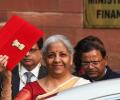
'... that it once again shies away from renewing its commitment to strategic divestment,' points out A K Bhattacharya.

China has filed a complaint against India in the World Trade Organization (WTO) over New Delhi's subsidies for electric vehicles (EVs) and batteries. Commerce secretary Rajesh Agrawal said that the ministry will look at the detailed submissions made by China.

All eyes will be on whether Sitharaman provides the much-expected tax relief for the middle class, leaving more money in their hands, as there is tax buoyancy

RBI may think twice before agreeing with suggestions of a rate cut.
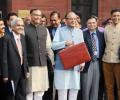
The fiscal deficit in current fiscal has been estimated at 3.9%.

'Rate cut looks unlikely and there is reason to believe that the cycle is over.'

Notwithstanding global headwinds, the Indian economy saw further momentum in October on the back of goods and services tax (GST) rate rationalisation and festival spending, as indicated by high-frequency indicators, the Reserve Bank of India's (RBI's) monthly State of the Economy report said.

"The new structure will substantially reduce taxes on the middle class and leave more money in their hands, boosting household consumption, savings and investment," Sitharaman said presenting what was dubbed as 'reformist' budget for the next fiscal in Lok Sabha.

The critical information in the first quarter (Q1) gross domestic product (GDP) data relates to the proximity of real and nominal GDP growth rates at 7.8 per cent and 8 per cent, respectively. The implicit price deflator (IPD)-based inflation is only 0.2 per cent. This phenomenon has repeated after fifteen quarters.

"The policy of Macaulay, which sowed the seeds of mental slavery in India, will complete 200 years in 2035. This means there are 10 years left. Therefore, in these very 10 years, we all must come together to free our country from the slave mentality," he said.

'Calibrated depreciation will help rebalance external fundamentals, offset some of the tariff differentials with competitors, improve the competitiveness of domestic substitutes vis-a-vis Chinese imports, and contribute to the easing of financial conditions at a time when the inflation rate is unusually low,' explains Sajjid Z Chinoy, head of Asia Economics at JP Morgan.

Gold's glittering rally is expected to continue, with prices likely to climb towards $4,500 per ounce in overseas markets, supported by sustained global central bank purchases, persistent geopolitical tensions, and strong Asian demand, according to a report by Motilal Oswal Financial Services Ltd. Silver, which has outperformed gold in terms of returns so far this year, is projected to climb to around $75 per ounce, aided by robust industrial consumption and a widening supply deficit, the report said.
